
Irregular Verbs French Learners Need to Know
Mastering French verbs is essential for anyone learning the language. While regular verbs follow predictable conjugation patterns, irregular verbs in French can be tricky because they don’t always follow the rules. This guide will help you understand what makes a verb irregular, introduce the most common irregular verbs, and provide strategies to learn French effectively through immersion and practice.
What Are Irregular Verbs in French?
How irregular verbs differ from regular verbs
In French, regular verbs like most -er and regular -ir verbs follow predictable present tense endings and past tense patterns. Irregular verbs, on the other hand:
Stem changes
Often change their stem depending on the subject.
Unique endings
May have unique endings that don’t follow the standard patterns.
Different verb groups
Can belong to -er, -ir, or -re groups, but behave differently.
For example, the verb avoir (to have) is irregular because its forms in the present tense are:
| Subject | Conjugation (Present Tense) |
|---|---|
| je | ai |
| tu | as |
| il/elle/on | a |
| nous | avons |
| vous | avez |
| ils/elles | ont |
This irregularity makes French grammar more complex but also more expressive.
Why learning irregular verbs is essential
Irregular verbs are among the most frequently used verbs in French. Learning them is crucial because:
- They appear in everyday conversation.
- They are essential in reading, writing, and listening comprehension.
- Knowing irregular verbs allows you to build correct sentences across all tenses.
Without mastering them, your French language skills will be incomplete.
Common Irregular Verbs in French
Most frequent irregular ER, IR, and RE verbs
Here’s a list of common irregular verbs in French, including English translation and pronunciation:
| French Verb | English | Pronunciation |
|---|---|---|
| être | to be | etr |
| avoir | to have | ah-vwar |
| aller | to go | ah-lay |
| venir | to come | vuh-neer |
| faire | to do / make | fehr |
| prendre | to take | prahndr |
| pouvoir | can / to be able to | poo-vwar |
| devoir | must / to have to | duh-vwar |
| voir | to see | vwar |
| tenir | to hold | tuh-neer |
These verbs are irregular in different ways: some change stems, others have unique endings, and many are commonly used in both spoken and written French.
Examples in everyday sentences
Je viens à l’école tous les jours. (I come to school every day.)
Tu as un livre intéressant. (You have an interesting book.)
Nous faisons nos devoirs après le dîner. (We do our homework after dinner.)
Ils voient le professeur. (They see the teacher.)
Il doit partir maintenant. (He must leave now.)
Conjugation Tips for Irregular French Verbs
Present tense patterns and exceptions
Unlike regular verbs, irregular verbs often require memorizing their stems:
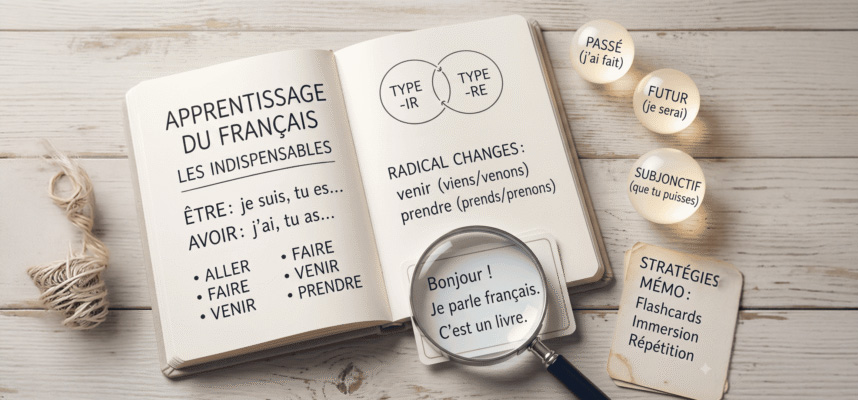
- Some -ir verbs like venir and tenir have stem changes (je viens / nous venons).
- Certain -re verbs like prendre change their final consonant in singular forms (je prends / nous prenons).
- High-frequency verbs like être and avoir have completely unique forms.
Example: Present tense of “venir”
| Subject | Stem | Ending | Conjugation |
|---|---|---|---|
| je | vien | s | viens |
| tu | vien | s | viens |
| il/elle | vien | t | vient |
| nous | ven | ons | venons |
| vous | ven | ez | venez |
| ils/elles | vienn | ent | viennent |
Past, future, and subjunctive forms
Passé composé
Passé composé: Most irregular verbs use avoir or être + past participle (j’ai fait, il est venu).
Future tense
Future tense: Add endings to the irregular stem (je pourrai, nous devrons).
Subjunctive
Subjunctive: Stem changes are common (que tu viennes, qu’il fasse).
Understanding these patterns allows you to use irregular verbs correctly across all tenses.
Strategies to Memorize Irregular French Verbs
Mnemonics, lists, and repetition
To learn irregular French verbs, you can:
Flashcards
Create flashcards including verb, English meaning, and pronunciation.
Mnemonics
Use mnemonics to connect a verb with an image or action.
Repetition
Repeat writing and speaking high-frequency verbs like être, avoir, aller, venir, faire.
Using immersion and context to remember irregular verbs
Practice speaking daily
Practice speaking French daily in your language school.
Listen to French
Listen to French podcasts, songs, or videos, paying attention to verbs in context.
Label daily actions
Label daily actions with irregular verbs: je vais, tu fais, il voit.
Combine learning methods
Combine reading, speaking, and writing to reinforce memory naturally.
By combining structured exercises with immersion, you can confidently learn French irregular verbs and apply them in real-life situations. At Institut de Français, regular practice and immersion give learners the opportunity to use irregular French verbs in real conversations, helping them build confidence and develop a more natural command of French. To take your practice further, discover our french immersion programs.


 English
  Русский
  Українська
  Deutsch
  Italiano
  Español