
Regular ER Verbs in French
Learning French verbs is an essential part of mastering the French language. Among all verbs in French, regular -er verbs are the easiest to start with because they follow a predictable conjugation pattern. This guide will explain how to identify, conjugate, and practice these verbs effectively, helping you learn French in an immersive way.
What Are Regular ER Verbs in French?
Definition and present tense endings
Regular -er verbs are French verbs that end in -er in their infinitive form. They follow a consistent pattern in the present tense, making them simpler to conjugate.
To form the present tense, remove the -er ending to find the stem, then add the following endings:
| Subject | Ending |
|---|---|
| je | -e |
| tu | -es |
| il/elle/on | -e |
| nous | -ons |
| vous | -ez |
| ils/elles | -ent |
For example, the verb aimer (to like) becomes:
- j’aime
- tu aimes
- il/elle/on aime
- nous aimons
- vous aimez
- ils/elles aiment
How to identify ER verbs that are regular
To identify regular -er verbs:
Infinitive
The infinitive ends in -er (except aller, which is irregular).
Consistent stem
The stem remains the same for all forms except minor spelling changes (like manger → nous mangeons).
Standard endings
They follow standard present tense endings.
Common Regular ER Verbs in French
Frequently used regular ER verbs
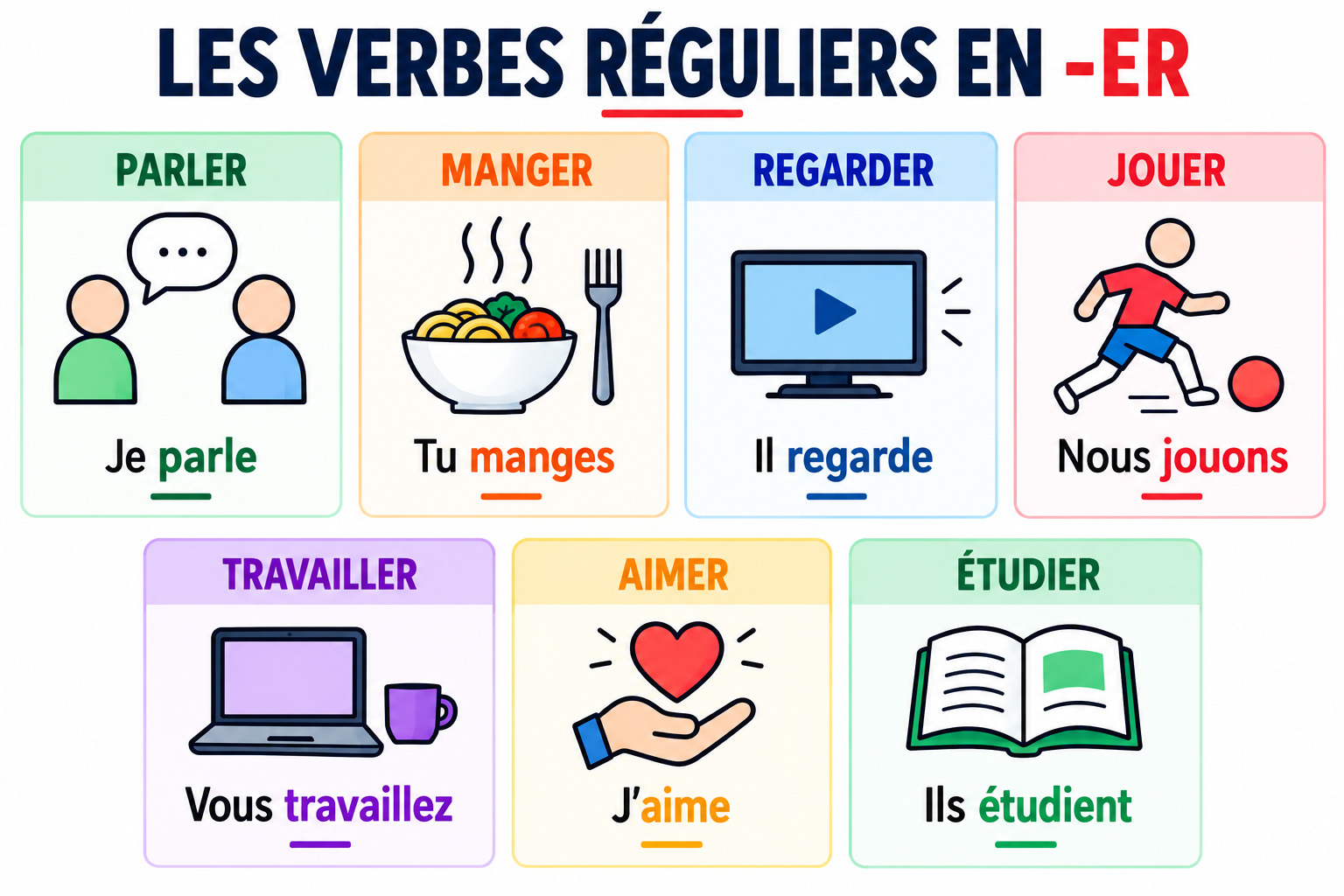
Here is a table of commonly used regular -er verbs, including English translation and pronunciation:
| French Verb | English | Pronunciation |
|---|---|---|
| aimer | to like / love | eh-may |
| manger | to eat | mahn-zhay |
| parler | to speak | par-lay |
| regarder | to watch | ruh-gar-day |
| jouer | to play | zhoo-ay |
| travailler | to work | tra-va-yay |
| étudier | to study | ay-tu-dee-ay |
These regular -er verbs are part of the largest category of verbs in French, making them a perfect starting point for beginners.
Examples in simple sentences
Je parle français
Je parle français tous les jours. (I speak French every day.)
Tu aimes le chocolat
Tu aimes le chocolat pour le goûter. (You like chocolate for a snack.)
Nous regardons un film
Nous regardons un film ce soir. (We are watching a movie tonight.)
Ils jouent au football
Ils jouent au football après l’école. (They play soccer after school.)
How to Conjugate Regular ER Verbs in French
Present, past, and future tense endings
Present tense
Use the standard endings: -e, -es, -e, -ons, -ez, -ent.
Past tense
Past tense (passé composé): Use avoir + past participle formed by replacing -er with -é.
Example: j’ai parlé (I spoke).
(be careful : a few verbs use être + past participle : e.g : je suis monté.e)
Future tense
Add future endings to the infinitive form: -ai, -as, -a, -ons, -ez, -ont.
Example: nous parlerons (we will speak).
Notes on spelling changes and pronunciation
Some regular -er verbs require slight spelling changes to maintain pronunciation:
Manger → nous mangeons
Extra e keeps the soft g sound.
Commencer → nous commençons
ç changes the c sound to soft s.
Remember that nous and vous forms are particularly important in spoken French, as they are used in formal situations and in the classroom.
Tips to Practice Regular ER Verbs
Exercises for daily practice
Conjugation drills
Pick 3-5 regular -er verbs and conjugate them in the present tense for all subjects.
Sentence creation
Use each verb in a simple sentence to reinforce meaning.
Flashcards
Include French verb, English translation, and pronunciation.
Immersion techniques to reinforce learning
Speak French daily
Speak French daily in your language school or online courses.
Label objects and actions
Label objects and actions around you using verbs like manger, regarder, jouer.
Watch and listen
Watch French videos or listen to songs, noting regular -er verbs in context.
Combine different exercises
Combine reading, writing, and speaking exercises to strengthen your memory.
By following these steps, learners can master regular -er verbs quickly and confidently, forming a strong foundation for more complex French grammar.
Regular practice and real-life immersion can make this process even more effective, giving you more opportunities to use these verbs naturally. An intensive french course can provide the structured practice and daily exposure needed to turn these grammar rules into confident French communication.



 English
  Русский
  Українська
  Deutsch
  Italiano
  Español