
Regular IR Verbs in French: Complete Guide
Learning French can be exciting, especially when you start understanding how verbs work. In this guide, we focus on regular -ir verbs, which are a core part of French grammar. By mastering regular French -ir verbs, you’ll be able to conjugate many commonly used French verbs and communicate with confidence.
What Are Regular IR Verbs in French?
Definition and conjugation pattern of regular IR verbs
Regular -ir verbs are French verbs that end in -ir and follow a predictable conjugation pattern. Unlike irregular -ir verbs, they don’t change their stem when you conjugate them. This makes them easier to learn for beginners.
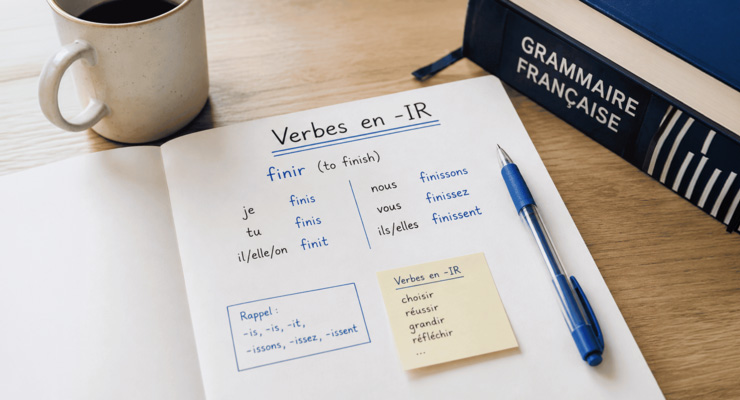
For example, finir (to finish) is a regular -ir verb. Its stem is fin- and you simply add the endings for each tense.
How to recognize IR verbs that follow the regular pattern
To spot regular French -ir verbs:
Regular Pattern
- The infinitive ends in -ir.
- The stem remains consistent across conjugations.
- Their present tense endings follow the regular -ir pattern: -is, -is, -it, -issons, -issez, -issent.
Tip
Tip: Not all verbs ending in -ir are regular. Some are irregular French -ir verbs like venir (to come).
Common Regular IR Verbs in French
List of frequently used regular IR verbs
Here’s a handy table of common regular French -ir verbs, including their English translations and pronunciation:
| French Verb | English | Pronunciation |
| finir | to finish | fee-neer |
| choisir | to choose | shwah-zeer |
| grandir | to grow | grahn-deer |
| réfléchir | to reflect/think | ray-flay-sheer |
| réussir | to succeed | ray-oo-seer |
| obéir | to obey | oh-bay-ear |
| punir | to punish | poo-neer |
These regular French verbs are part of the second group (-ir verbs), often referred to as verbes du deuxième groupe.
Examples of regular IR verbs in sentences
- Je finis mes devoirs tous les soirs. (I finish my homework every evening.)
- Tu choisis toujours le meilleur. (You always choose the best.)
- Nous réussissons à chaque examen. (We succeed in every exam.)
How to Conjugate Regular IR Verbs in French
Present tense endings for regular IR verbs
Regular -ir verbs in the present tense follow this pattern:
| Subject | Ending | Example: finir |
| je | -is | je finis |
| tu | -is | tu finis |
| il/elle/on | -it | il finit |
| nous | -issons | nous finissons |
| vous | -issez | vous finissez |
| ils/elles | -issent | ils finissent |
This consistent pattern makes learning French verbs simpler than irregular conjugations.
>Past tense
For the past tense (passé composé):
- Combine the auxiliary avoir with the past participle, which ends in -i.
- Example: J’ai fini mes devoirs (I finished my homework).
Future tense
For the future tense:
- Add the future endings to the infinitive: -ai, -as, -a, -ons, -ez, -ont.
- Example: Nous finirons bientôt (We will finish soon).
Tips to Practice Regular IR Verbs
Exercises and daily practice strategies
- Daily conjugation drills: Pick three regular -ir verbs and conjugate them in all present tense forms.
- Sentence creation: Use each verb in a full sentence to reinforce meaning and structure.
- Flashcards: Include French verbs, English translation, and pronunciation.
Example exercise: Conjugate choisir in present tense for all subjects.
Immersion techniques to remember regular IR verbs
Use French in conversation
Speak with classmates or teachers in your French school. Try to naturally use tu, nous, il, vous, ils, elles forms in conversation.
Label objects and actions
Label objects and actions around you with verbs like finir, choisir, réfléchir.
Listen to French
Listen to French podcasts or songs, focusing on regular -ir verbs.
Practice reading
Practice reading short stories or dialogues in French to identify patterns.
By combining structured exercises with immersive techniques, you’ll learn French -ir verbs quickly and naturally.
The best way to learn irregular verbs and practice using them naturally is through an intensive french course, where you can practice regularly in real French-speaking situations.

 English
  Русский
  Українська
  Deutsch
  Italiano
  Español