
Irregular IR Verbs French Learners Must Know
Mastering French verbs is essential if you want to learn French effectively. While many regular -ir verbs follow predictable rules, irregular -ir verbs can be more challenging because they don’t follow the regular patterns.
In this guide, you’ll discover the most important irregular IR verbs, how their conjugation works, and practical strategies to use them confidently in real-life communication.
What Makes an IR Verb Irregular in French?
Differences between regular and irregular IR verbs
In French grammar, regular -ir verbs follow a clear structure. You remove the -ir ending, get the stem, and add the appropriate endings.
However, irregular -ir verbs:
Stem changes
Often have a stem change between singular forms (je, tu, il/elle) and plural (nous, vous, ils/elles)
Final consonant
May drop or modify a final consonant
Irregular patterns
Do not always follow the standard -ir conjugation patterns
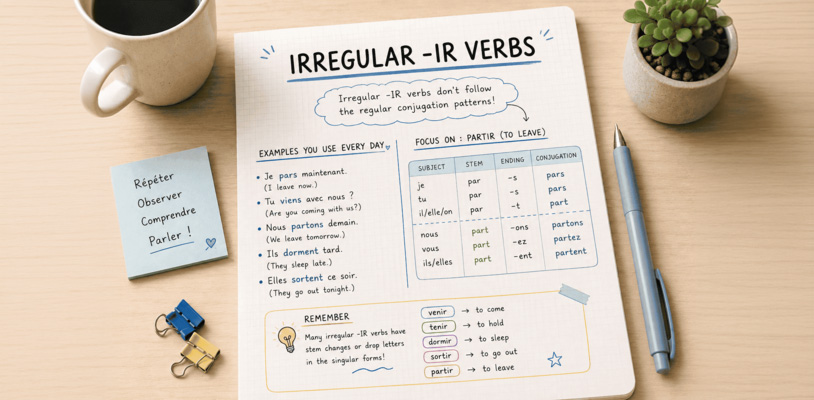
For example, partir (to leave) is an irregular -ir verb:
- je pars
- tu pars
- il part
- nous partons
- vous partez
- ils partent
Unlike regular -ir verbs, the stem changes from par- to part-.
Common conjugation patterns for irregular IR verbs
Even though they are irregular, many French -ir verbs share similar patterns:
- Dormir / sortir / partir → drop a consonant in singular
- Venir / tenir → strong stem change (je viens / nous venons)
- Some verbs mix regular and irregular forms
These patterns help learners recognize similarities and reduce memorization.
List of Important Irregular IR Verbs in French
Frequently used irregular IR verbs
Here is a table of common irregular -ir verbs, with English translations and pronunciation:
| French Verb | English | Pronunciation |
|---|---|---|
| partir | to leave | par-teer |
| venir | to come | vuh-neer |
| sortir | to go out | sor-teer |
| dormir | to sleep | dor-meer |
| tenir | to hold | tuh-neer |
These French verbs ending in -ir are widely used in daily conversations, so they are essential to learn early.
Examples of irregular IR verbs in context
Je pars maintenant. (I leave now.)
Tu viens avec nous ? (Are you coming with us?)
Nous partons demain. (We leave tomorrow.)
Ils dorment tard. (They sleep late.)
Elles partent à 8h. (They leave at 8 a.m.)
Learning verbs in context helps you understand how they function naturally in the language.
How to Conjugate Irregular IR Verbs in French
Present tense patterns for irregular IR verbs
Below is a visual conjugation chart showing the stem change of partir in the present tense:
| Subject | Stem | Ending | Conjugation |
|---|---|---|---|
| je | par | -s | pars |
| tu | par | -s | pars |
| il/elle/on | par | -t | part |
| nous | part | -ons | partons |
| vous | part | -ez | partez |
| ils/elles | part | -ent | partent |
This clearly shows how irregular -ir verbs differ from regular verbs, especially in singular vs plural forms.
Passé composé
Passé composé: Use avoir or être + past participle
Example: nous avons fini vs elle est partie
Future tense
Future tense: Add endings to irregular stems
je viendrai, nous partirons
Conditional
Conditional: Same stem as future
je viendrais, vous partiriez
Understanding these tenses helps you communicate clearly in both spoken and written French.
Learning Tips for Irregular IR Verbs
Memory techniques for mastering irregular IR verbs
To learn irregular verbs, you can:
Group verbs
Group verbs like dormir, sortir, partir together
Use patterns
Use patterns instead of memorizing one by one
Flashcards
Create flashcards with verb, meaning, and pronunciation
Repetition is key when dealing with irregular forms.
Practice exercises and immersion strategies
Practice speaking daily
Practice speaking daily using je, tu, nous, vous, ils, elles
Build sentences like
tu pars, vous partez, elles partent
Listen to real conversations
Listen to real conversations to hear French IR verbs in context
Use immersive techniques
Use immersive techniques at your language school
At Institut de Français, regular practice and immersion give learners the opportunity to use irregular -ir verbs in real conversations, helping them build confidence and develop a more natural command of French. To take your practice further, discover our intensive french course.


 English
  Русский
  Українська
  Deutsch
  Italiano
  Español