
French Nouns: A Complete Guide for Beginners
Learning French nouns is one of the first and most important steps when you learn French. Unlike English, every noun in French has a gender (masculine or feminine), which affects how you use articles like le and la, as well as adjectives.
At the Institut de Français, we help students master nouns in French through immersive learning. You don’t just memorize vocabulary - you actively use the French language in real-life situations.
What Are French Nouns?
Definition and role of nouns in French grammar
A noun is a word used to name a person, place, thing, or idea. In French grammar, nouns are essential because they form the foundation of sentences.
Examples of French nouns:
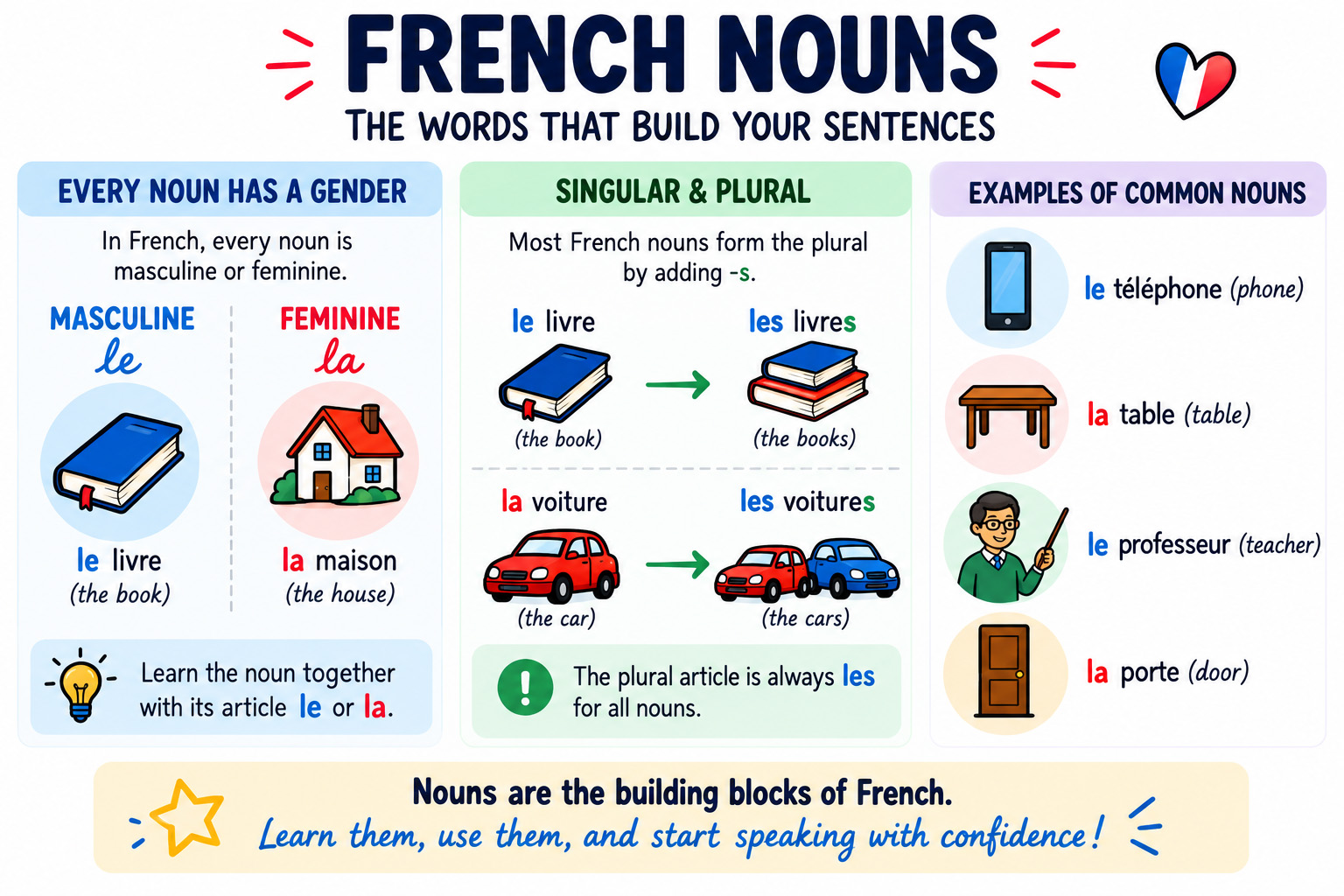
Le livre
le livre (the book)
La maison
la maison (the house)
Le professeur
le professeur (the teacher)
Each noun is always used with an article such as le (masculine) or la (feminine).
Differences between French nouns and English nouns
One of the biggest differences between French and English is that French nouns always have gender.
In English
“the book” → no gender
In French
le livre → masculine
la table → feminine
This means you must learn the noun together with its article, not just the word itself.
Gender of French Nouns
Masculine and feminine French nouns explained
Every French noun is either:
Masculine
Masculine → uses le
Feminine
Feminine → uses la
Examples:
Le livre
le livre (book) → masculine
La voiture
la voiture (car) → feminine
👉 This concept of gender is essential in French grammar, and it affects many other parts of the sentence.
How to guess the gender of French nouns
Although you often need to memorize gender, there are useful patterns:
👉 Common rules:
Words ending in -e
Words ending in -e are often feminine (la table)
Common endings
Words ending in -age or -ment are often masculine (le fromage, le document)
⚠️ However, there are exceptions, so exposure and practice are key.
Singular and Plural French Nouns
Rules for forming plural nouns in French
To make most French nouns plural, you simply add -s:
Le livre
le livre → les livres
La maison
la maison → les maisons
👉 Note: The plural article becomes les for both masculine and feminine nouns.
Common irregular plural forms
Some nouns have irregular plural forms:
Le cheval
le cheval → les chevaux
Le journal
le journal → les journaux
L’œil
l’œil → les yeux
These forms are common, so it’s important to recognize them early when learning French words.
Visual overview (singular → plural)
| Singular | Plural |
|---|---|
| le livre | les livres |
| la voiture | les voitures |
| le cheval | les chevaux |
| le journal | les journaux |
Common French Nouns for Everyday Use
Basic French nouns for daily conversations
Here is a table of common French nouns with English translation and pronunciation:
| French Noun | English | Pronunciation |
|---|---|---|
| le livre | book | luh leevr |
| la maison | house | lah meh-zon |
| le travail | work | luh tra-vai |
| la voiture | car | lah vwah-tyur |
| le téléphone | phone | luh tay-lay-fon |
| la table | table | lah tabl |
| le professeur | teacher | luh pro-feh-sur |
| la porte | door | lah port |
👉 These are essential nouns that people use every day in French conversations.
Examples of French nouns in sentences
Je lis un livre
Je lis un livre. (I read a book)
La maison est grande
La maison est grande. (The house is big)
Le professeur parle
Le professeur parle. (The teacher speaks)
La voiture est rapide
La voiture est rapide. (The car is fast)
👉 Notice how the article changes depending on gender.
Tips to Learn and Remember French Nouns
Memorization techniques for French nouns
To effectively learn French nouns, follow these tips:
Learn with the article
Always learn the noun with its article (le / la)
Group by theme
Group nouns by theme (food, travel, home)
Use flashcards
Use flashcards with gender color coding
Learn in context
Repeat nouns in context, not in isolation
👉 This helps you remember whether a noun is masculine or feminine.
Learning French nouns through immersion
The best way to truly master nouns in French is through immersion. At Institut de Français, students:
Hear native speakers
Hear native speakers use nouns naturally
Practice in context
Practice in real-life situations
Build vocabulary
Build vocabulary faster through experience
Instead of memorizing long lists, you use French nouns in context, which makes learning more natural and long-lasting.
If you want to learn the noun system faster and speak confidently, immersive learning is the most effective method.
👉 Contact us to discover how our programs in France can help you master French naturally.
Building your vocabulary becomes much easier when you use new nouns in real conversations instead of studying them in isolation. An intensive french course gives you the opportunity to practice vocabulary and grammar every day in real French-speaking situations.


 English
  Русский
  Українська
  Deutsch
  Italiano
  Español