
French Pronouns: Complete Guide to Pronouns in French
What Are French Pronouns?
Definition and role of pronouns in French
French pronouns are essential elements in the French language. A pronoun is a word that replaces a noun to avoid repetition in sentences. In French, pronouns are used to refer to people, objects, or ideas already mentioned or understood from context.
For example:
Je le vois
“I see him/it” — le replaces a masculine object or person.
Avoid repetition
Pronouns replace nouns that have already been mentioned.
Build sentences
Pronouns are an essential part of natural French sentences.
Using French pronouns correctly is crucial to mastering French grammar, as they impact word order, verb conjugation, and sentence meaning.
Differences between French and English pronouns
While French pronouns often work like English pronouns, there are notable differences:
Gender
French distinguishes masculine and feminine.
Number
French distinguishes singular and plural.
Word order
Object pronouns usually appear before the verb.
En & y
Some French pronouns, like en and y, have no direct English equivalent and must be understood in context.
| French Pronoun | English Equivalent | Pronunciation |
|---|---|---|
| je | I | zhuh |
| tu | you (informal) | too |
| il | he / it | eel |
| elle | she / it | el |
| nous | we | noo |
| vous | you (formal/pl) | voo |
| ils | they (m) | eel |
| elles | they (f) | el |
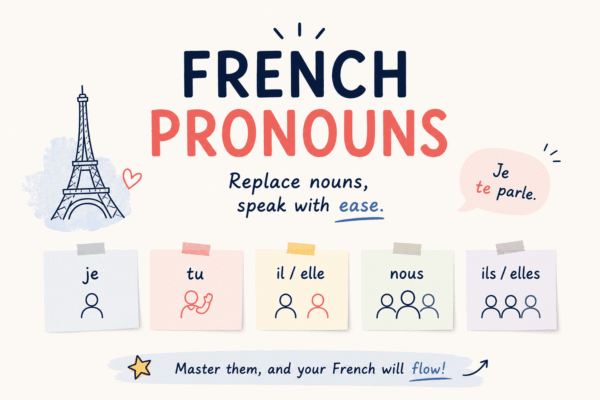
Types of French Pronouns
Subject pronouns in French
Subject pronouns replace the noun that performs the action of the verb. They are essential for French sentences:
| French Subject Pronoun | English | Pronunciation |
|---|---|---|
| je | I | zhuh |
| tu | you | too |
| il | he | eel |
| elle | she | el |
| nous | we | noo |
| vous | you | voo |
| ils | they | eel |
| elles | they | el |
💡 Tip: The pronoun je always comes before the verb in spoken and written French, just like in English.
Object pronouns in French
Object pronouns receive the action of the verb. They can be direct or indirect.
Direct object pronouns
Replace nouns directly receiving the action: le, la, les, l’
Indirect object pronouns
Replace nouns introduced by à: me, te, lui, nous, vous, leur
| Type | French Pronoun | English | Pronunciation |
|---|---|---|---|
| Direct | le | him/it | luh |
| Direct | la | her/it | lah |
| Direct | les | them | lay |
| Indirect | lui | to him/her | lwee |
| Indirect | leur | to them | luhr |
Reflexive pronouns in French
Reflexive pronouns are used when the subject performs the action on itself. They are used with reflexive verbs:
| French Pronoun | English | Pronunciation |
|---|---|---|
| me / m’ | myself | muh |
| te / t’ | yourself | tuh |
| se / s’ | himself / herself / itself | suh |
| nous | ourselves | noo |
| vous | yourselves | voo |
| se / s’ | themselves | suh |
Example: Je me lave → “I wash myself”
How to Use French Pronouns in Sentences
Word order with French pronouns
French pronouns usually come before the verb, unlike English. For example:
English
I see him.
French
Je le vois.
In compound tenses like passé composé, the pronoun comes before the auxiliary verb: Je l’ai vu → “I saw him/it”
Common sentence structures
French pronouns can appear in multiple positions depending on the sentence:
Simple present
Je te parle. (I am speaking to you.)
Compound tense
Elle lui a donné un livre. (She gave him a book.)
Negative sentence
Nous ne les aimons pas. (We don’t like them.)
Graph for clarity:
[Subject Pronoun] + [Object Pronoun] + [Verb] + [Other Elements]
Ex: Je le vois à l’école.
Common Mistakes with French Pronouns
Errors French learners often make
Here are some common mistakes to watch out for:
Misplacing pronouns
French learners often put the pronoun after the verb (Je vois le → ❌).
Gender confusion
Using le for feminine nouns (la should be used).
Direct vs. indirect
Il lui voit (❌) instead of Il le voit (✅).
Tips to avoid confusion with pronouns
Memorize tables
Memorize tables of subject and object pronouns.
Check gender
Always check the gender and number of nouns being replaced.
Practice structures
Practice common sentence structures to internalize word order.
Tips to Practice and Master French Pronouns
Exercises and repetition techniques
Practice regularly to become more comfortable with different types of French pronouns:
Replace nouns
Replace nouns in sentences with pronouns to train reflexive and object pronouns.
Write daily
Write 10 sentences daily using different types of pronouns.
Use flashcards
Use flashcards for subject pronouns and object pronouns.
Learning French pronouns through immersion
An immersive approach works best:
Speak French
Join a French-speaking school or club.
Speak aloud
Speak aloud using pronouns to improve fluency.
Listen naturally
Listen to French conversations and note pronoun usage.
👉 Example activity: Replace every noun you hear in a sentence with the correct pronoun. This helps you see French pronouns in action.
Mastering French pronouns becomes much easier when you hear and use them regularly in real conversations rather than studying them in isolation. An french immersion programs gives you the opportunity to practice French every day in real French-speaking situations.
Whether you are looking for an immersive program for seniors or prefer to learn alongside younger people, you will be satisfied with the French courses at Institut de Français.



 English
  Русский
  Українська
  Deutsch
  Italiano
  Español