
Reflexive Verbs French Learners Need to Know
Learning French reflexive verbs is essential if you want to speak French naturally in everyday situations. These verbs are extremely common in daily routines like waking up, getting dressed, or taking a shower and they play a key role in French grammar.
At the Institut de Français, we help students master reflexive verbs through immersive learning in France, so you don’t just memorize rules - you actually use French in real life.
What Are Reflexive Verbs in French?
Definition of reflexive verbs in French grammar
In the French language, reflexive verbs (also called pronominal verbs) are verbs where the subject performs an action on oneself. These verbs always use a reflexive pronoun such as me, te, se, nous, vous, se.
For example:
Je me lave
Je me lave (I wash myself)
Tu te réveilles
Tu te réveilles (you wake yourself up)
The reflexive pronoun se is the base form you see in the infinitive (e.g., se laver, se réveiller).
How reflexive verbs differ from regular verbs
Unlike regular verbs, reflexive verbs in French always include a pronoun that matches the subject pronoun:
| Subject | Reflexive Pronoun |
|---|---|
| je | me |
| tu | te |
| il / elle | se |
| nous | nous |
| vous | vous |
| ils / elles | se |
Regular verb
Regular verb: je lave la voiture (I wash the car)
Reflexive verb
Reflexive verb: je me lave (I wash myself)
Common Reflexive Verbs in French
List of frequently used reflexive verbs French students learn
Here is a table of common French reflexive verbs with pronunciation:
| French Verb | English Translation | Pronunciation |
|---|---|---|
| se laver | to wash oneself | suh lah-vay |
| se réveiller | to wake up | suh ray-vay-yay |
| se coucher | to go to bed | suh koo-shay |
| se doucher | to take a shower | suh doo-shay |
| se brosser | to brush | suh bro-say |
| se coiffer | to comb one’s hair | suh kwah-fay |
| se maquiller | to put on makeup | suh mah-kee-yay |
| se raser | to shave | suh rah-zay |
| se promener | to take a walk | suh pro-meh-nay |
| se reposer | to rest | suh ruh-po-zay |
These common reflexive verbs are used every day in French conversations.
Examples of reflexive verbs in everyday sentences
Je me lave
je me lave les mains (I wash my hands)
Tu te réveilles
tu te réveilles tôt (you wake up early)
Elle se couche
elle se couche à 22h (she goes to bed at 10 pm)
Nous nous promenons
nous nous promenons (we take a walk)
Ils se reposent
ils se reposent (they rest)
Notice how French uses les mains / les cheveux / les dents instead of “my hands / my hair / my teeth.”
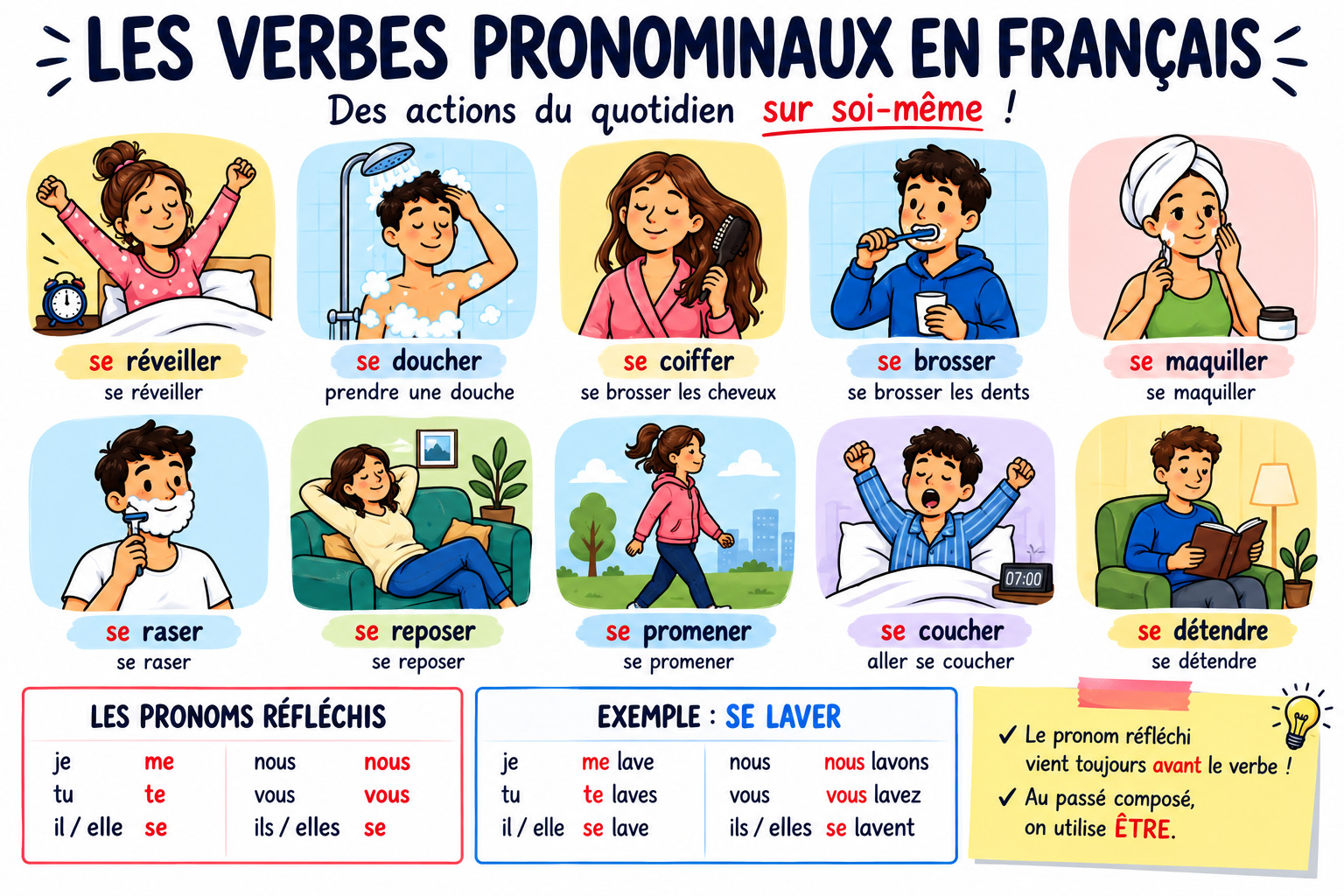
How to Use Reflexive Verbs in French
Reflexive pronouns and sentence structure
The structure of a French reflexive verb is:
Subject + reflexive pronoun + verb
je me lave
tu te douches
nous nous reposons
vous vous levez
Using reflexive verbs in present tense
Here’s a simple graph to understand how reflexive verbs are conjugated:
| Subject | Conjugation |
|---|---|
| je | me lave |
| tu | te laves |
| il | se lave |
| elle | se lave |
| nous | nous lavons |
| vous | vous lavez |
| ils | se lavent |
| elles | se lavent |
Before the verb
The reflexive pronoun always comes before the verb
Spoken French
In spoken French, this becomes very natural with practice
Reflexive Verbs in Different Tenses
Reflexive verbs in past tense (passé composé)
In the passé composé, reflexive verbs use être as the auxiliary verb:
subject + reflexive pronoun + être + past participle
Je me suis lavé
je me suis lavé
Elle s’est réveillée
elle s’est réveillée
Nous nous sommes promenés
nous nous sommes promenés
Agreement: In many cases, the past participle agrees with the subject (gender and number), although this can vary depending on the sentence structure.
Reflexive verbs in future and other tenses
Reflexive verbs can be used in all tenses:
Future
je me laverai (I will wash myself)
Imperfect
je me lavais (I was washing myself)
Conditional
je me laverais (I would wash myself)
The reflexive pronoun stays before the verb in all cases.
Tips to Master Reflexive Verbs in French
Common mistakes with reflexive verbs French learners make
Here are typical mistakes in learning French reflexive verbs:
Forgetting the pronoun
❌ Forgetting the reflexive pronoun
Using avoir
❌ Using avoir instead of être in past tense
Translating directly
❌ Translating directly from English
Misplacing the pronoun
❌ Misplacing the pronoun in negative sentences
Example
je ne me lave pas (correct)
Practice strategies and immersion tips
To truly master reflexive verbs in French, you need to go beyond theory.
👉 Effective strategies:
Practice daily routines
Practice daily routines in French: je me réveille, je me douche…
Use real conversations
Use verbs in real conversations.
Repeat common patterns
Repeat common patterns like tu te, nous nous, vous vous.
Build sentences
Build sentences with real-life context.
At Institut de Français, our immersive programs help students use reflexive verbs naturally, not just memorize them. By living and speaking French every day, you quickly improve your fluency and confidence.
For learners who want to turn grammar knowledge into everyday communication, an intensive french course offers a practical way to use reflexive verbs repeatedly in real French-speaking situations.



 English
  Русский
  Українська
  Deutsch
  Italiano
  Español